Posted in Uncategorized

Back from break!

I totally started typing up a post reflecting on all my pre-break learnings but never posted. So I am going to combine with my goals and thoughts for coming back from break.

First – I need to spend a moment reflecting on the Math bingo/hyperdoc/choose your own adventure… (I really need a better name for that.) First go at it was a little rough. I think it was too much to do in one week while also learning how to use it, submit evidence, and understand expectations. Today I rolled it out again for a second time and it went much better. This time we have all week, we’re not so rushed, and we know a bit more than we did last time. Also, it seems as though I need to find the perfect balance of ease and rigor. The students liked this material today better because it was more accessible as an “on your own” thing. I can’t wait to see the evidence at the end of the week.

Next – I need to say – I tried out Flip Grid in my 10th grade class today. Amazing! I started them off with a story problem task. This was not an easy assignment to do, especially coming back from break. However, kids jumped right in. Then I had them use Flip Grid to record their explanations of their thoughts. I spent the time to watch the videos, which students recorded, in twos or threes. I loved it. I spent about 1 minute per video watching. It gave me a quick snap shot of what they knew and what they didn’t. Not only did I get insight into their work but also their thinking. It definitely needs work on what I expect and don’t expect but that’s my learning on how to use after watching students use it. This could be a really fun thing when interjected appropriately. I can’t wait to do it more. Plus – management wise, grading was super easy because it was about a 1 minute video per student and I got way more out of that one minute than I get looking at the completion of their worksheets. SCORE! 🙂

Last thing I want to reflect on before I end this post and my day is that Professional Development and growth is an exhausting task. Incorporating new technology has such a huge learning curve to it. There is a lot of preparation time learning: Learning how to make edulastic assessments, learning how to operate new formats, learning how to create hyperdocs, reflecting on the progress etc. However, some of these learnings are powerful and it’s time you still would spend working on stuff. For example, with edulastic being in my repertoire now, I spend less time grading assessments and more time planning for them. With real-time feedback and the ability to display student data, I can better assess the areas of growth and success. I can intervene more in the moment. With things like Flip Grid, I spend 1-3 minutes per video watching. I would spend the same time, or longer, grading their work and providing feedback. Here, I could provide feedback, type it, and email it to the student. Faster and I don’t have to remember to hand back the papers. (Totally my weakness.)

Professional growth is hard. Change is hard. However, nothing worth much ever came easy. I am thankful to Tyler for putting on this challenge. I appreciate learning new things in an engaging fashion. Think — if I am enjoying this — what power could I have by adapting this to my classroom? Food for thought for another day maybe?

Until next time! 🙂
Posted in Uncategorized

Goals & More Goals 3.25.18

This is a super short week here at SHS. Three days and we kick off spring break. I’m excited about the opportunities for things and goal setting.

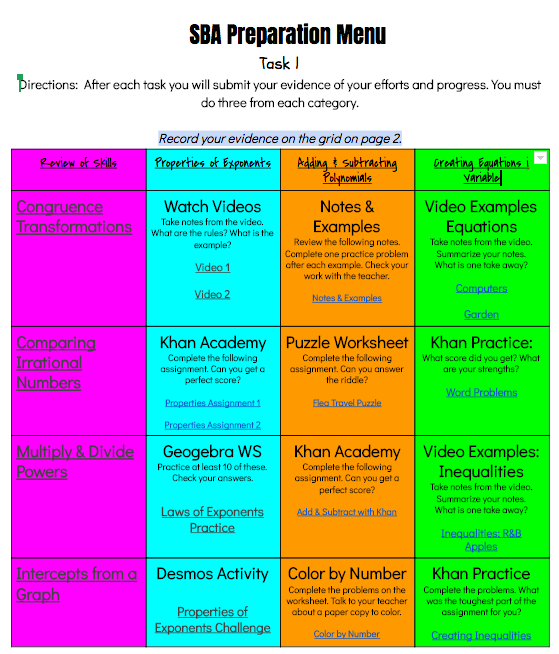
First, I want to comment on a goal I set last week. That SMART piece where it was reasonable and timely. My measurable goal is that I would have a “Bingo Board” of a menu for students to be able to have an element of choice in their work this week. I wanted to have this done by today. March 25. It was. I rolled it out during second period. There were some hiccups… like I forgot to assign a copy to each student. (Oops! Kind of important when it comes to the evidence.)

Check it out: It’s a screen short below but there are links embedded to the tasks/activities I wanted students to do.

Super excited about this document. This week will tell some highlights and some flaws.

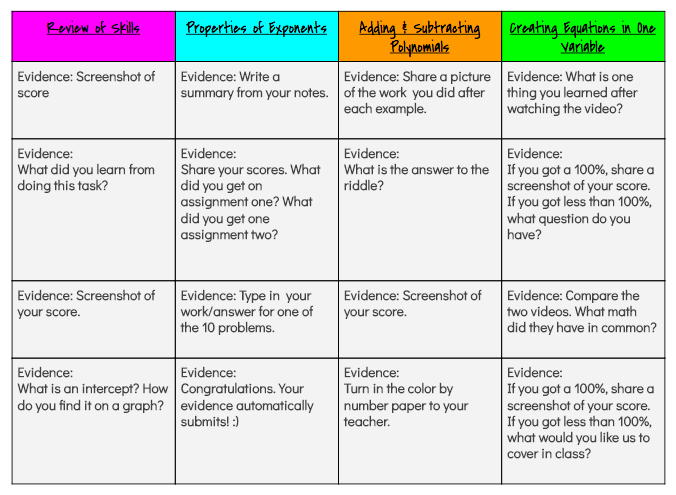
The other part of this goal was to find a way to collect evidence. I wanted this evidence to be as varied as the tasks themselves. Not all evidence has to be the same and there are different ways to assess if a student knows something or completed a task than simply recording a score. I wish I was better at this. (Do I smell a new goal for after break?)

I love that students can take screen shots, they can reflect on their learning, ask questions or provide a summary.

This week – I want to work on this. Refine this. Prepare another one for when we come back from break. With this, I’m realizing a need for scaffolds. Scaffolding: How do I input evidence? How do I summarize a video? The answer to “What? I was supposed to take notes?” How do I take a screenshot?

Another goal I have this week: Create an edulastic assessment from scratch. No question bank. No snap quiz. Master how to format questions in edulastic.

So… Here goes this week’s goals: Write an assessment. Find a way to scaffold processing of information.

Posted in Uncategorized

Just a Weekly Reflection: Blogging Itself & New Things in the Classroom

So my idea of this blog is going to transform and mold as I continue to use it. I’ve realized in just my short two (now three) blog posts that it is going to be so helpful for me. I have known for a long time I’m a verbal processor. I need to talk things out. I like to make lists. I like to use words to organize my thoughts. I’ve had some awesome people listen to this as time goes on. However, it isn’t always possible for someone to be there for me as I circulate my thoughts. As a result, I never fully formulate them and my own growth stalls. This blog has allowed me a place to verbally process without having to consume someone else’s time. Which is gold for me.

This blog admittedly started because I was slightly interested in how it would go…. that and I have a tendency to be a little competitive. 😉 However, good things in life can surprise us from unexpected places. I am by no means a professional blogger and am unsure exactly how much I’ll actually keep this up. However, I’m rolling with it and finding value.

This week has been a week of innovation for me. First task of the week was meeting with a colleague, in a different department, for ideas of hands on/alternate methods to cover mathematics topics. A simple 15 minute conversation has unfolded into a vision that will require some time. However, phase one will be implemented tomorrow. Very excited about this. Hoping to start quality conversations and encourage students to use visual models to form arguments around the mathematics in this article: https://gizmodo.com/whats-bigger-1-3-pound-burgers-or-1-4-pound-burgers-1611118517 Fingers crossed we’ll have a taste of success.

Second task of the week was to take on the creation of a document to differentiate for my new class. I’ve now finished this task and assigned it. Let’s see how implementation works. I’ll update on that next week. 🙂

Last task of my week I was hoping to accomplish was a new technology activity in my classroom. I discovered this a while ago but never used it with my Geometry class. This activity was a Desmos Classroom Activity called a “Polygraph”. What was wonderful about this activity is that it was inclusive of all my students: My level one students were able to access and ask questions. My level four students were able to have fun with the task. In addition to being inclusive, it got my students talking about math and thinking about math differently. Hello CCSS-M Claim 3! Communicating reasoning and critiquing the reasoning of others.

Now the trick to moving forward is answering the following questions:

*** What worked? How can I recreate this?

*** What didn’t work? How can I fix this? What ways can it be improved?

*** Did it have a positive impact on student learning? If so, then it was worth the effort. Isn’t that always the goal?

Posted in Uncategorized

Transforming Differentiation: Mulling Ideas

This year has been a unique year for me in the fact that I’m now the proud parent of a school age kid! (Where the heck did time go?)

As the parent of a school age kiddo, I’m in awe at the togetherness and amazingness of elementary teachers. However, I’m also realizing that learning is learning and some of the tried and true strategies of elementary teachers could have their place in high school classrooms. That’s right, I said it. Now, I’m not talking about the songs and dances (which by the way, my kiddo loves). They’re not my personality and the level of willingness in adolescents isn’t there.

What I’m mulling over is the structure of choice that some elementary teachers are geniuses with do. I’m considering blending the style of homework my child gets with a hyperdoc for use in my classroom. Her homework is a menu of sorts that kind of reminds me of a bingo board. She doesn’t have to do all the tasks to count it as finished. However, there is element of choice when we sit down to do her work. There are categories these fall into that span the focus of her elementary. I love this. Because I love this as a teacher parent, I’m wondering if I can adapt this to work for my students.

Specifically, I’m thinking around SBA review or even differentiation in my classes. My initial thoughts are this: What if I take the standards I want my students to focus on during the period of time (Weekly? Monthly? Biweekly?) and create a menu/hyperdoc of work that can be done around these standards. These may include a variety of formats… perhaps Khan Academy? Maybe some Desmos? Maybe some Geogebra? Maybe just some traditional math worksheets? Then students can show proficiency by taking an Edulastic assessment and meeting a mastery score before moving on. This is lofty but doable.

I like this idea and want to run with it but have to start in steps…. to keep this as a SMART goal. It’s specific, it’s measurable, it’s attainable, but I have to keep it realistic and timely.

1st: I need to identify my timelines I’d like to consider? I’m learning towards biweekly. Monthly with high schoolers who are expected to be independent doesn’t have enough reminders or immediacy. Weekly is a bit harder for me to manage when I’m considering my own learning in this process.

2nd: I need to identify the standards I want to focus on with my groups. How many standards would be appropriate?

3rd: I need to then identify the work/assignments/resources that this menu will link the students to. These need to be high quality resources and will take time to formulate.

Last – I need to develop the assessment that allows students to show mastery/proficiency on the targets of focus.

Today – through this blog, I’ve decided to do this biweekly to begin with. My goal is to have my first one ready by Monday, March 25. <– See there’s the “T” of the SMART.

Next – I need to determine which standards I want to address this way and then determine the best resources.

Posted in Uncategorized

Re-Integrating Tech

This week marks the beginning of a new trimester. During this transition, I have switched over two of my three classes. One to a new class to me that I’ve never taught before. This class poses a unique challenge as it is a blend of 10th and 11th grade students who need a math credit. In this class, that means I also have a blend of students who do and do not need to also pass the state test for graduation because some of the students met the requirement though alternatives.

With this transition, I have decided to integrate technology back in my classroom in order to provide some more opportunities for differentiation. One way we started this is through setting up all students on Edulastic for future assessments. We also set up students on Khan Academy and set a mastery goal. This mastery goal will allow students to work at their own pace through elements of Algebra and Geometry and meet them where they are. The nature of this type of course is that the gaps in each students’ learning differs based on the credit they’re missing and which portion of the credit they’re missing.

I’m tired after a week of establishing norms for new classes and establishing norms around technology into my year long class. However, there are benefits to this. Today I used Desmos to help my students review solutions to systems of equations. The engagement of my easily distracted class seemed to be better today. The access to Desmos gave my students a different access point in something that would normally be frustrating to access. That made the end of a week a highlight.

I’m excited to see where this transition goes. I’m nervous about how it will play out. I want to use technology to enhance the learning experience. I want it to be a tool for students that makes the learning experience not better. I’ve tried to integrate it before and there were pros and cons. So I’m trying to keep the pros, learn from the cons, and improve practice. However, in just nine months of taking break from my familiar platforms, they no longer feel as familiar and I have many things i need to relearn.

So as I end this week, I’ll be looking forward to next week. Ways to improve. Ways to change. Ways to wrap my head around the new technologies and changes to the old technologies.